
Trailer covers: storage or travel, PVC or canvas, and what to measure
A trailer spends most of its life parked in the sun. How to choose a cover that lasts, why a storage cover and a travel cover are different jobs, and what to measure so it fits the first time.
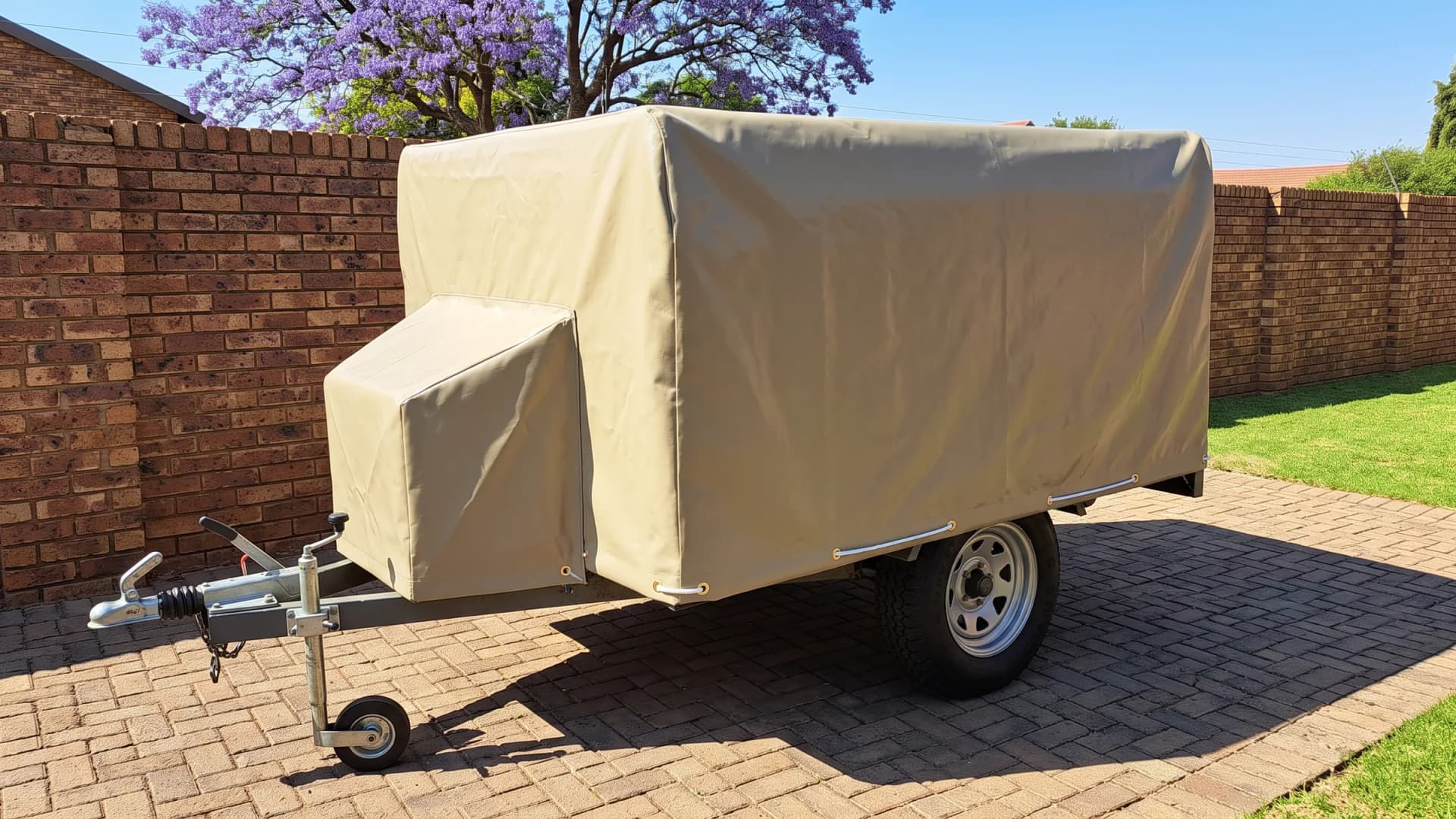
Search for a trailer cover and most of what comes back is sold by size: 5 ft, 6 ft, 7 ft, with or without a nose cone. That works if your trailer happens to match the one the cover was patterned on. Often it does not, and a cover that is 100 mm too long flaps, rubs, and holds water in its folds.
A trailer spends far more time parked than towed, usually in a driveway or a yard, in full sun. That is where a cover earns its keep. Here is how to choose one that fits and lasts.
First decide the job: storage or travel
These are two different covers, and most disappointment comes from asking one to do the other's job.
A storage cover goes over the whole trailer while it is parked: the body, the lid or tent, the nose cone, and as far down the sides as you want it. Its job is to keep sun, rain, dust, and bird droppings off for months at a time. It drops loosely enough to go on and off without a fight.
A travel cover goes over the load bin while you tow. It is cut tight to the bin, sits on the rail, and is roped down hard through every eyelet so it survives hours at 120 km/h. Our December load cover guide covers that job in detail, including how to tie one down.
If you tow a few times a year and park the rest, start with the storage cover. If the trailer works every week, you probably need both.
PVC or canvas
- PVC (550, 700, or 800 gsm) is fully waterproof, with RF heat-welded seams. Right for a trailer parked in full sun and rain with no shelter, and the only choice for a travel cover. Expect 7 to 10 years in SA conditions. For a storage cover, 550 gsm is usually enough. Go heavier if the cover also travels, or if it sits over sharp edges like a roof rack or jerry can holders.
- Canvas breathes, letting trapped moisture escape, with double-needle stitched seams. Right for a trailer under a carport or shade cloth, where condensation underneath is a bigger risk than direct rain. Expect 5 to 8 years.
Many of the covers sold off the shelf are light polyethylene or coated fabric. Under a roof, as a dust cover, they do the job. Parked in full sun through a Highveld or KZN summer, a light sheet does not last the way heavy PVC does. Our PVC vs canvas guide goes deeper on the materials.
What makes a cover fit
Cut to the trailer, not the size class. We cut every cover to the actual body, to within 10 mm of your measurements. A close fit sheds water off the edges instead of pooling it on top, and gives the wind nothing to grab.
Shaped around what sticks out. Off-road and camping trailers are rarely plain boxes. Jerry can holders, gas bottle brackets, spare wheels, roof racks, rooftop tents, and kitchen hatches all need room. We cut around them or add a storm patch where they would rub, so the cover sits flush instead of tenting.
Reinforced where it wears. Corners get double-layer reinforcement. These are the points that rub on the body every time the wind moves the cover, and the first place a cheap cover splits.
Eyelets and rope at the hem. Eyelets set into a properly hemmed edge, with rope laced through them and tied off to the trailer frame. It lets you pull the cover tight exactly where it needs it, and an eyelet is easy to replace if one ever pulls.
Before you cover it
- Wash and dry the trailer first. Covering it dusty or damp traps grit and moisture against the paint and the tent fabric for months.
- Leave airflow at the base. A cover sealed to the ground becomes a condensation tent. Leave a gap, or choose canvas if the trailer stands somewhere damp.
- Re-tension after the first windy week. Rope stretches and the cover settles. A quick pull keeps it from working loose.
- Take it off now and then. Check the tyres, the tent canvas, and the seals between trips. A cover protects the trailer, it does not replace looking at it.
For a boat on a trailer, the same thinking applies to the hull. Our winter storage cover guide covers boats and caravans.
Already have a cover?
We repair covers regardless of who made them: torn eyelets, opened hems, panels split by the sun, and holes worn through at the corners. A repair is often far cheaper than a new cover. Our repair or replace guide will tell you which one yours needs.
What to send us
Measure the trailer body's length, width, and height, and tell us:
- whether the cover is for storage, travel, or both
- whether it should cover the nose cone, the drawbar, or the wheels
- what is mounted on the outside: racks, jerry can or gas bottle holders, a spare wheel, a rooftop tent
- whether the trailer stands in full sun or under a roof
A photo from a front corner and one from the side make the quote faster and the fit better. WhatsApp 083 631 5329 and we will come back within 24 hours with a price and a lead time. There is no minimum order, we deliver across South Africa, and the full range of vehicle, boat, and trailer covers is on our equipment covers and bags page.
Frequently asked
Size it to your trailer, not to a label. Two 7 ft trailers from different makers rarely share the same body height, nose cone, or lid. Measure the body's length, width, and height, note anything that sticks out, and send a photo. We cut to within 10 mm of those measurements.