
Winter storage covers for boats and caravans: what actually protects them
A boat or caravan parked up for winter needs more than a generic cover. Custom PVC or canvas, cut to the hull or body, keeps rain, UV, and dust off through months of standing still.
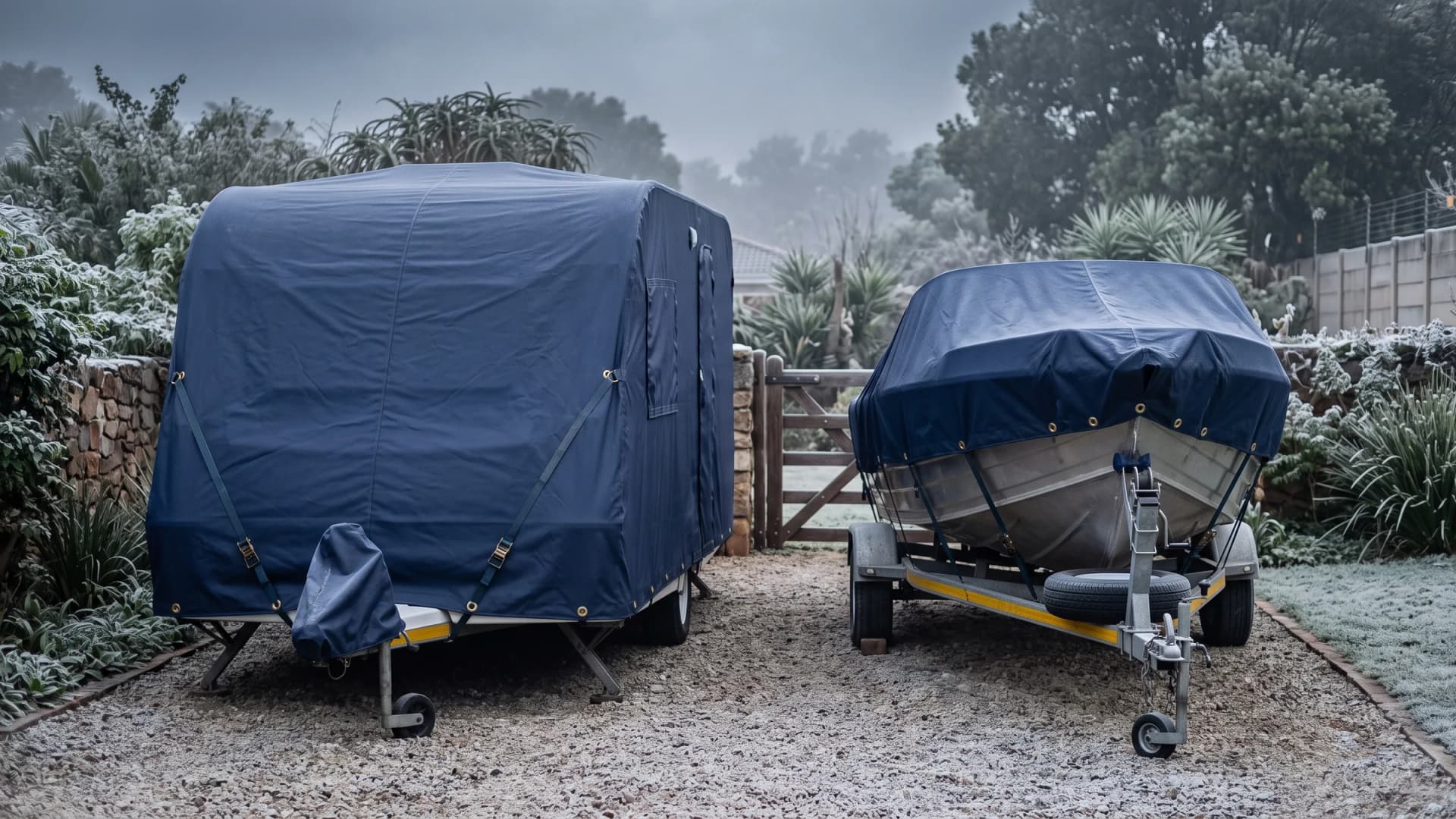
Most boats and caravans do more sitting than moving. Winter is when that shows: months on a trailer or a driveway, exposed to rain, UV, and dust, with nobody checking on them between trips. A cover cut to the actual shape is the difference between pulling off a clean hull or body in spring and finding chalky gelcoat, a mildewed interior, or a cracked dashboard.
Why a generic cover fails
A one-size "fits most" cover from a hardware store drapes loosely, flaps in wind, and rubs a groove into paintwork and gelcoat at every high point: gunwales, roof vents, tow hitches. It also traps rain in folds instead of shedding it, so water sits and finds the one seam that leaks. A cover cut to the actual boat or caravan sits close, sheds water off the edges, and does not move in wind.
PVC or canvas
- PVC (550, 700, or 800 gsm) is fully waterproof, with RF heat-welded seams. Right for a boat or caravan standing fully exposed to rain and sun with no shelter. Expect 7 to 10 years in SA conditions.
- Canvas breathes, letting trapped moisture escape, with double-needle stitched seams. Right for storage under a carport or shade netting, or anywhere condensation under the cover is the bigger risk than direct rain. Expect 5 to 8 years.
Fully exposed on a driveway or a yard, PVC is the safer call. Under a carport, lean-to, or shade cloth, canvas often does the job at a lower cost.
Cut to the hull or body, not a generic length
Every cover is cut to the specific boat or caravan, to within 10 mm of spec. Bow rails, aerials, roof vents, air conditioners, and tow hitches get cutouts or storm patches so the cover sits flush instead of tenting over them. Corners get double-layer reinforcement. Edges are tightened with eyelets and rope so wind cannot work the cover loose over a long stretch of no one checking on it. We also repair existing covers, whoever they were made by, so a torn tie or a failed seam does not mean a full replacement.
What to check before you cover it
- Wash and dry first. Covering a wet hull or a damp caravan roof traps moisture underneath and encourages mildew rather than preventing it.
- Ventilate where you can. A cover that seals completely against the ground turns into a condensation tent. Leave a gap at the base, or choose canvas, where drainage or airflow underneath is limited.
- Check tie-downs after the first windy week. Rope stretches. A quick re-tension keeps the cover from working loose over months of standing.
Made to your trailer, not just the vessel
The same build covers the trailer as well as the boat or caravan itself, so wheels, jockey wheels, and drawbars stay dry and rust-free too. If it ever tears, we repair it at the Durban factory: welded patches on PVC, re-stitching on canvas, eyelet replacement.
How to order
Measure length, width, and height at the widest points (bow rail, roof AC unit, awning box), note anything that sticks out, and send it through with a photo. WhatsApp 083 631 5329 and we will quote within 24 hours. There is no minimum order: one boat, one caravan, or a yard full of both. See the full range on our equipment covers page, and for anything unusual we also do fully custom work.
Frequently asked
PVC if it is standing fully exposed and has to be waterproof. Canvas if it is under partial cover and you want it to breathe, which reduces condensation and mildew underneath over a long standing period.