
Before the storms: a ten-minute check for every cover you own
Summer storms find every weak eyelet, perished rope, and sagging cover. A ten-minute check before the season starts, what a cover can and cannot do against hail, and what to fix now while it is quick.
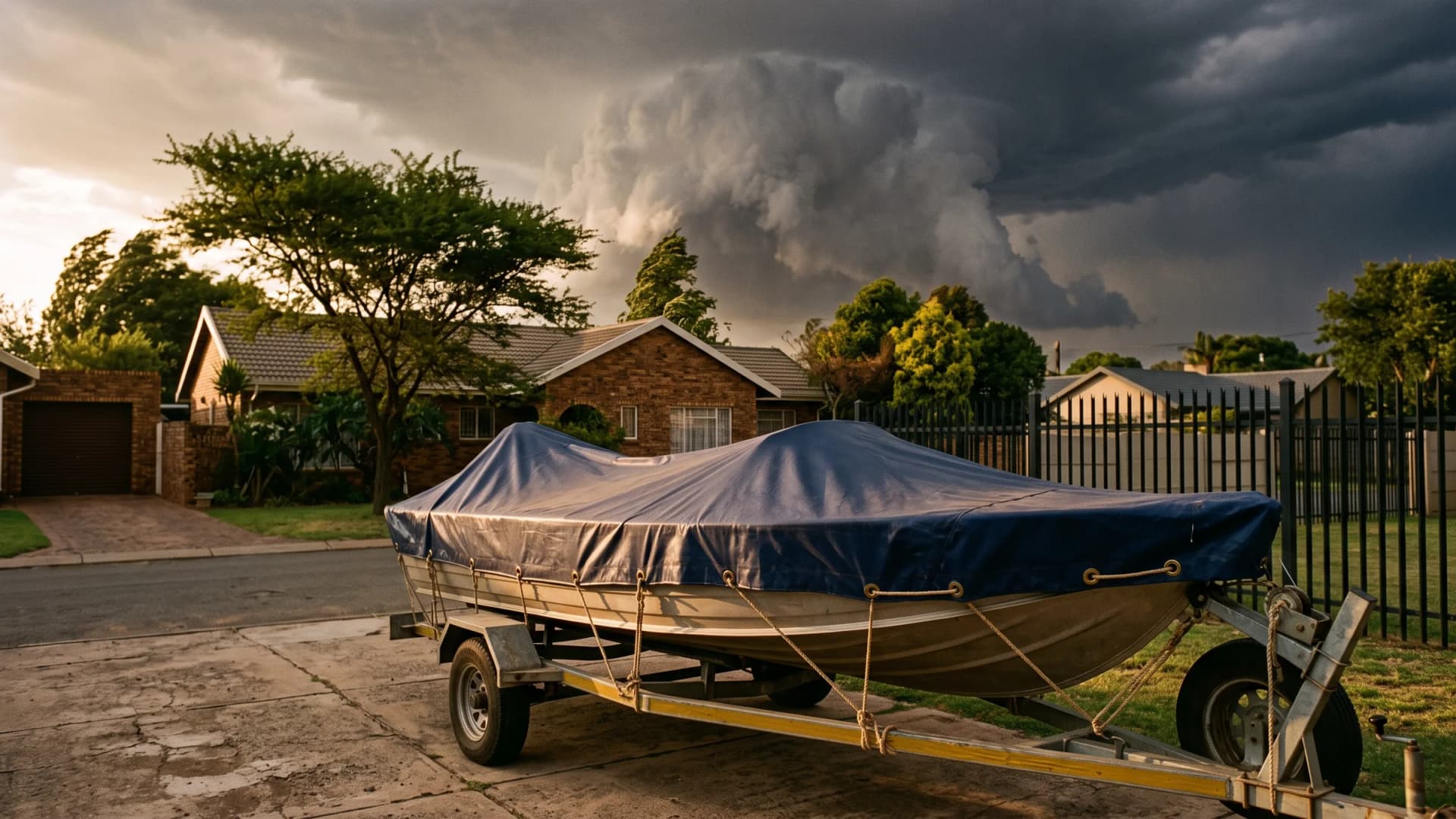
From October the Highveld starts building its afternoon thunderstorms, and the coast gets its own share of wind and cloudbursts. A storm rarely destroys a good cover. What it does is finish off a tired one: the eyelet that was already pulling, the rope that perished in the winter sun, the dip where water has been pooling since the last rain.
All of that is visible now, on a dry afternoon, in about ten minutes a cover.
What a cover can and cannot do
Be honest with yourself about this one. No cover is hailproof. A fitted PVC or canvas cover takes the sting out of small hail, keeps out the grit, leaves, and branches that a storm throws around, and keeps the water out. Large hail goes through fabric and dents what is underneath. If a boat or a car is going to live outside through hail season, a carport or a garage is the real protection, and the cover is for everything else.
The other half of the honesty: a loose cover in wind is worse than no cover at all. It flaps, it rubs paint and gelcoat, and every flap works the eyelets a little further out of the hem. A cover earns its keep by staying tight.
The ten-minute check
Go round each cover in this order.
- Look at every eyelet. An eyelet that has pulled oval, rusted, or started to tear the hem around it is the one that lets go first in a storm, and it takes the hem with it.
- Bend the rope. Rope that has been in the sun perishes. If it is faded, stiff, furry, or snaps when you bend it hard, replace it. It is the cheapest fix on this list.
- Run a hand along the hems and seams. You are feeling for a weld that has started to lift or stitching that has opened.
- Test the sheet itself. Rub it with a dry palm and fold a corner hard. Chalk on your hand or a crease that goes white means the material is near the end of its life. Our repair or replace guide explains both tests properly.
- Find the low points. Anywhere the cover dips, water will pool. Pooled water is heavy, it stretches the sheet, pulls on the eyelets, and eventually tears through or spills into whatever is underneath.
- Check what the cover ties to. A cover is only as strong as the trailer cleat, rail, or frame it is roped to. A rusted tie point fails before the cover does.
- Ask whether it actually fits. A generic tarp over an odd shape leaves loose flaps, and loose flaps are where the wind gets in.
Fix the pooling with a high point so the water runs off: a padded pole, a proper cover support, or an upturned bucket under the lowest dip. Then tension the rope again.
Item by item
- Boats and caravans. Pay special attention to the hull or the roof edge, where the cover rubs when it moves. If it is wearing through there, a reinforcement patch now is a small job. Our storage covers guide covers fit and tie-down in more detail.
- Trailers and bakkie loads. Rope stretches when it gets wet. After the first proper rain, go back and pull everything tight again.
- Generators. Storms bring power cuts, and power cuts bring the generator out. Never run a generator under its cover, and let it cool before you cover it again. The generator covers article explains why.
- Blinds and awnings. When a storm is coming, roll outdoor blinds up. A rolled-down PVC blind in a strong gust acts like a sail and puts huge load on its fittings. If a fitting has worked loose over winter, get your installer back to refit it before the season rather than after the first storm.
- Truck and load tarps. Check the corners and the edges that sit on the load bed. That is where the tarp wears through first.
After a storm
Walk round the next morning. Tip pooled water off gently from the edge rather than pushing up from underneath with a broom handle, which is how a lot of punctures happen. Check the eyelets and the hems again, because a storm finds the next weakest point. If a canvas cover is soaked, loosen it enough for air to move underneath so the item below can dry out.
Fix it now, not in December
A small repair now is a quick job. The same repair after a storm has torn the hem open is a bigger one, and in December everyone wants their cover back before the holiday.
We repair covers regardless of who made them: pulled and torn eyelets, opened hems, lifted seams, tears in the sheet, and worn spots that need a reinforcement patch. The work is heat welding on PVC and industrial stitching on canvas, the same techniques we use on our own products. Our welding, stitching, and sewing page lists it all.
If the cover is finished, we build a new one cut to the actual item, in PVC at 550, 700, or 800 gsm depending on how exposed it is, or canvas where it needs to breathe. Boat, caravan, and trailer covers tie down with eyelets and rope. There is no minimum order. The full range is on our equipment covers and bags page.
What to send us
A photo of the whole cover, a close-up of any damage with something for scale, and a line on what it covers. WhatsApp 083 631 5329 and we will come back within 24 hours with a repair price, or a price for a new cover if the old one has had its day. Most small repairs are done in a day or two.
Frequently asked
Only partly. No cover is hailproof. A fitted PVC or canvas cover takes the sting out of small hail and keeps out the grit, leaves, and branches a storm throws around, but large hail needs a roof. If something valuable lives outside through hail season, a carport or garage is the real answer.