
Generator covers for load shedding season: keep your backup power dry
Winter load shedding puts your generator outside in the rain, frost, and dust. A custom PVC or canvas cover keeps water out of the alternator and rust off the frame. Cut to your machine, repairable, no minimum order.
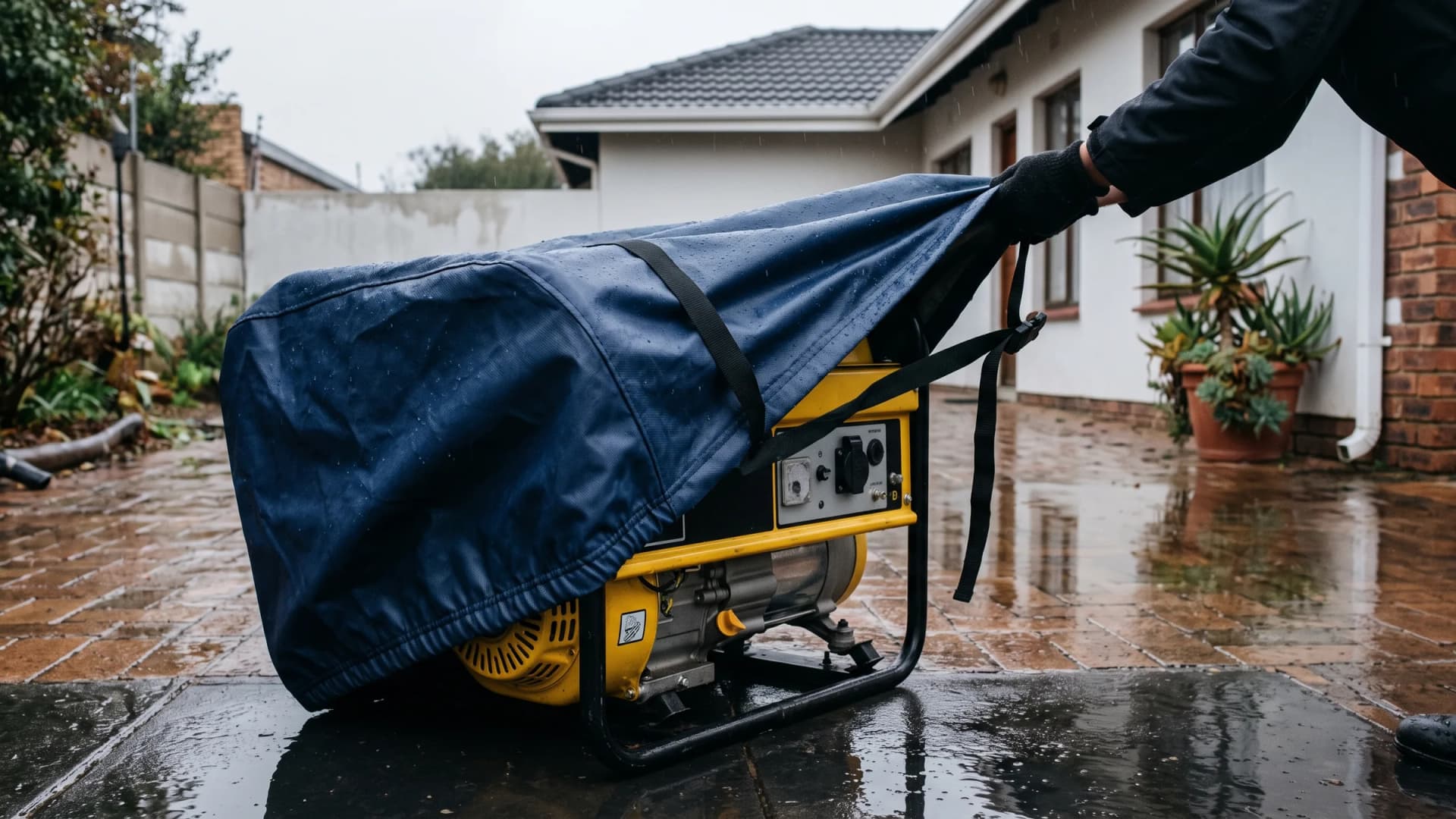
Winter is when the generator earns its keep, and winter is also when it lives in the worst conditions of the year. Most home and small-business generators sit on a patio, a carport slab, or an open trailer, and between outages they collect rain, frost, and dust. The usual failure is not the engine; it is water. Moisture in the alternator windings, a rusted fuel tank, corroded terminals, and a recoil starter that seizes exactly when stage 6 hits.
A fitted cover is the cheapest protection your backup power will ever get. Here is how to choose one, and the safety rules that go with it.
Why a fitted cover and not a plastic sheet
A loose tarp or a "universal" cover does two things badly. It flaps in wind, which chafes the paintwork and works itself loose, and it drapes to the ground, which traps ground moisture underneath and turns the cover into a condensation tent. A cover cut to the machine, with an elastic hem or drawstring sitting just below the frame rails, sheds rain and still lets air move underneath.
PVC or canvas
The same logic that applies to boat and bakkie covers applies to generators:
- PVC (550, 700, or 800 gsm) is fully waterproof, with RF heat-welded seams. Right for a generator that stands fully exposed to rain. Expect 7 to 10 years in SA conditions.
- Canvas breathes, letting moisture escape, with double-needle stitched seams. Right for a machine that gets covered while still damp, or lives in a humid coastal spot. Expect 5 to 8 years.
For most load shedding setups, where the generator stands under partial shelter and gets covered between outages, 550 gsm PVC does the job. Fully exposed on a farm or a site, go 700 or 800 gsm.
The safety rules
A cover protects a resting machine. It must never be on a running one.
- Never run the generator under its cover. A generator needs open airflow for cooling and to disperse exhaust. Uncover it completely before you start it, every time.
- Let it cool before covering. An exhaust silencer stays hot long after shutdown and will melt PVC on contact. Give it 20 to 30 minutes.
- Keep the fuel cap vent clear. Cover the machine, not the jerry cans; fuel should be stored separately anyway.
Made to your machine
Every cover is cut to the generator, not to a generic size, to within 10 mm of spec. Handles, wheels, lifting bars, and cable ports get cutouts or zipped flaps so you can plug in without stripping the whole cover off. Corners get double-layer reinforcement, and tie-down points get webbing straps with brass eyelets every 500 mm as standard, so a highveld wind does not take the cover to the neighbour's yard. If it ever tears, we repair it at the Durban factory: welded patches on PVC, re-stitching on canvas, eyelet replacement.
The same construction covers the rest of the backup kit: inverter trolleys, solar battery cabinets, and pump housings.
How to order
Measure length, width, and height at the widest points, note anything that sticks out (handles, exhaust, wheels), and send it through with a photo of the machine. WhatsApp 083 631 5329 and we will quote within 24 hours. There is no minimum order: one household generator or a fleet of site machines both get built. See the full range on our equipment covers page, and for anything unusual we also do fully custom work.
Frequently asked
No. Never cover a generator that is running or still hot. Exhausts stay hot long after shutdown, and a cover over a running machine traps heat and exhaust gas. Let it cool fully, then cover it.