Broiler curtains in summer: when the curtain becomes your ventilation
In winter a poultry curtain holds heat in. In an SA summer its job flips, and a curtain that jams, sags, or tears at the eyelets costs you airflow on the hottest afternoons. What to check before the heat and the storms arrive.
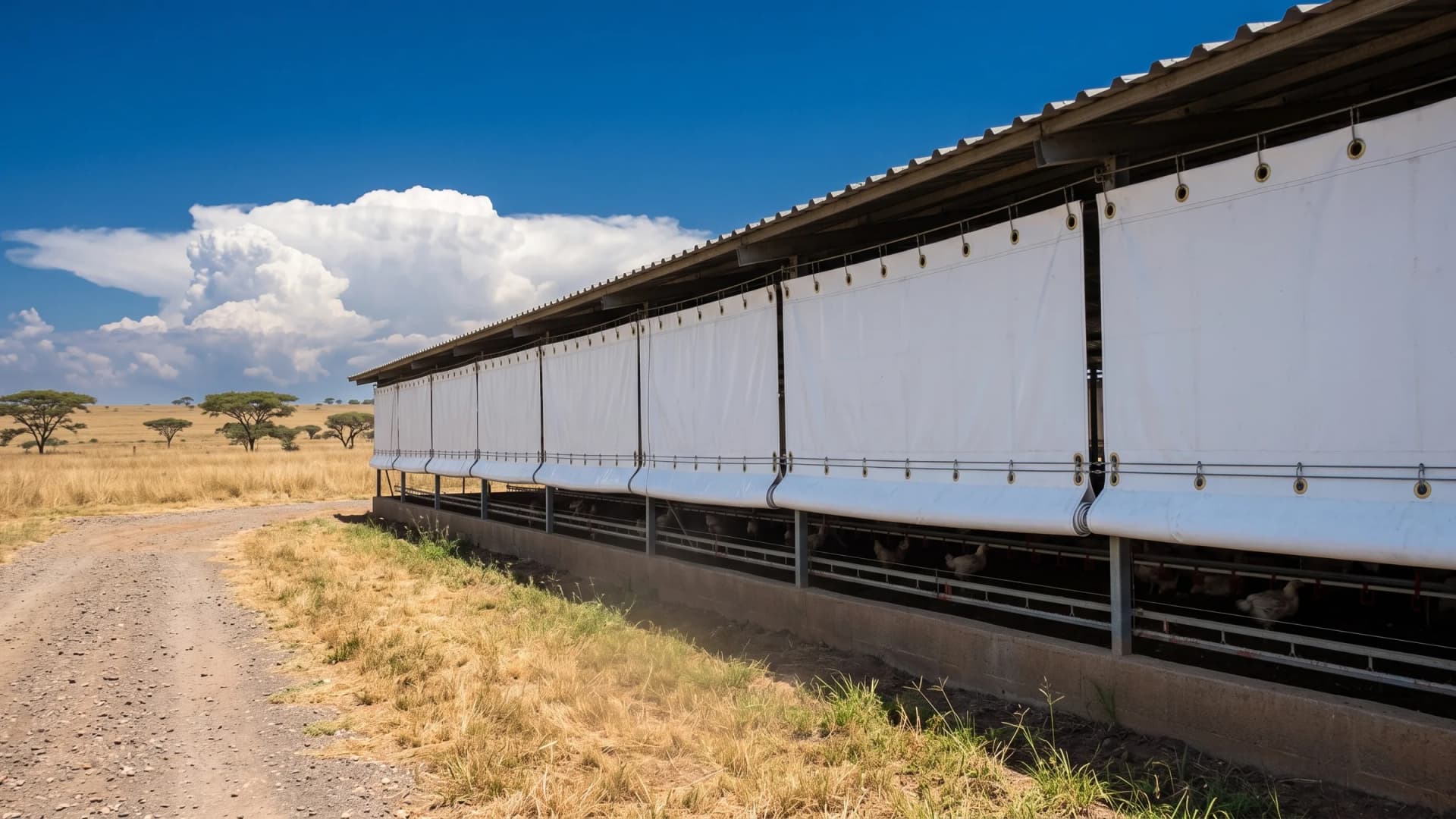
In July a broiler house curtain is a heat-holding wall. By November the job has flipped. On a hot afternoon the curtain is how air gets into the house, and a curtain that will not open fully, sags half-closed, or flaps loose in a storm is a ventilation problem you find out about at exactly the wrong moment.
Your ventilation programme belongs to you, your house manager, and your vet or integrator. What we can speak to is the curtain itself: what makes one work in summer, and what to check before the heat arrives.
What the curtain has to do in summer
- Open cleanly, all the way. On the hottest days you want the full sidewall available. A curtain that binds at one end, or a section that will not drop with the rest, blocks air across exactly the birds that need it.
- Close fast when a storm comes. Summer afternoon storms arrive quickly. Curtains have to come down and stay down in the wind that comes ahead of the rain.
- Survive the sun. Summer is when UV does its damage. Poor PVC goes chalky, then brittle, then cracks along the folds.
- Not add to the heat. Curtain colour matters in a hot region, which is where white comes in.
Why white for hot regions
We make poultry curtains in white, olive, black, and clear. White is UV-reflective and runs cooler inside the house, which is why it is our recommendation for hot regions. Olive and black are for blackout broiler grow-out. If you are replacing curtains on a house in a hot area, the colour decision is worth a conversation before you order.
The pre-summer curtain check
Walk the house in October, before the first real heatwave:
- Raise and lower every curtain. It should travel smoothly along its full length. Note any section that lags, binds, or folds unevenly.
- Check the eyelets along the cable line. Look for eyelets that have pulled, elongated, or torn into the hem. Each failed eyelet puts more load on its neighbours, and a storm finishes the job.
- Check the bottom pipe pocket. It holds the weighted pipe that keeps the curtain down. A torn pocket means a curtain that lifts and flaps in wind.
- Look at the PVC itself. Chalky, stiff, or cracked material along the fold lines has had its UV life. Patch what is local, and plan replacement for what is not.
- Check the ends. Gaps at the ends of the house let wind get behind the curtain in a storm, which is when tears start.
The pipe pocket and the cable eyelets are the first things to wear on any poultry curtain. Both are repairable, and fixing them in October costs far less than losing a curtain in a December storm.
Built for storm country
Our standard eyelet spacing along the cable line is 500 mm. For high-wind locations we close that up to 300 mm, which spreads the load across more points and keeps the curtain on the cable when the wind gets behind it. If your house sits on an exposed ridge or open land, ask for the high-wind spacing on replacement curtains. Our pre-storm cover check applies the same thinking to every other cover on the farm.
Repairs, whoever made them
We repair poultry and livestock curtains regardless of who made them: welded patches, eyelet replacement, and pipe-pocket repair. Send photos of the damage and we will quote the repair against a replacement, so you can decide on the numbers. For the cold-season side of the same curtains, see our winter poultry curtain guide.
How to order
Curtains are made to your house dimensions, in 550 gsm UV-stabilised PVC, with eyelets for the running cable along the top and a reinforced pocket for steel or PVC pipe along the bottom. Send the house length, the curtain drop, your preferred colour, and a photo of your current cable and raising hardware on WhatsApp 083 631 5329. We come back within 24 hours with a price and lead time. Full specs are on our agricultural curtains page.
Frequently asked
White. It is UV-reflective and runs cooler inside the house, which is why we recommend it for hot regions. Olive and black are for blackout grow-out, and clear or semi-clear suit greenhouse sidewalls.