Winter in the broiler house: poultry curtains that hold the heat
Cold nights cost broiler margin. Custom PVC poultry curtains in 550 gsm UV-stabilised PVC hold house heat, block draughts at bird level, and still let you ventilate. Made to any house size, repairable, no minimum order.
A winter night on the highveld or in the KZN midlands can drop below freezing, and a broiler house with tired curtains leaks heat all night. Day-old chicks need about 32 degrees, and even at four weeks the birds want around 21. Every degree the house loses to a gap, a tear, or a sagging curtain is a degree the birds replace by eating, and that shows up straight in your feed conversion.
A well-fitted PVC curtain is the cheapest piece of climate control on the farm. Here is what it does in winter, and how to tell if yours is ready.
What a winter-ready curtain does
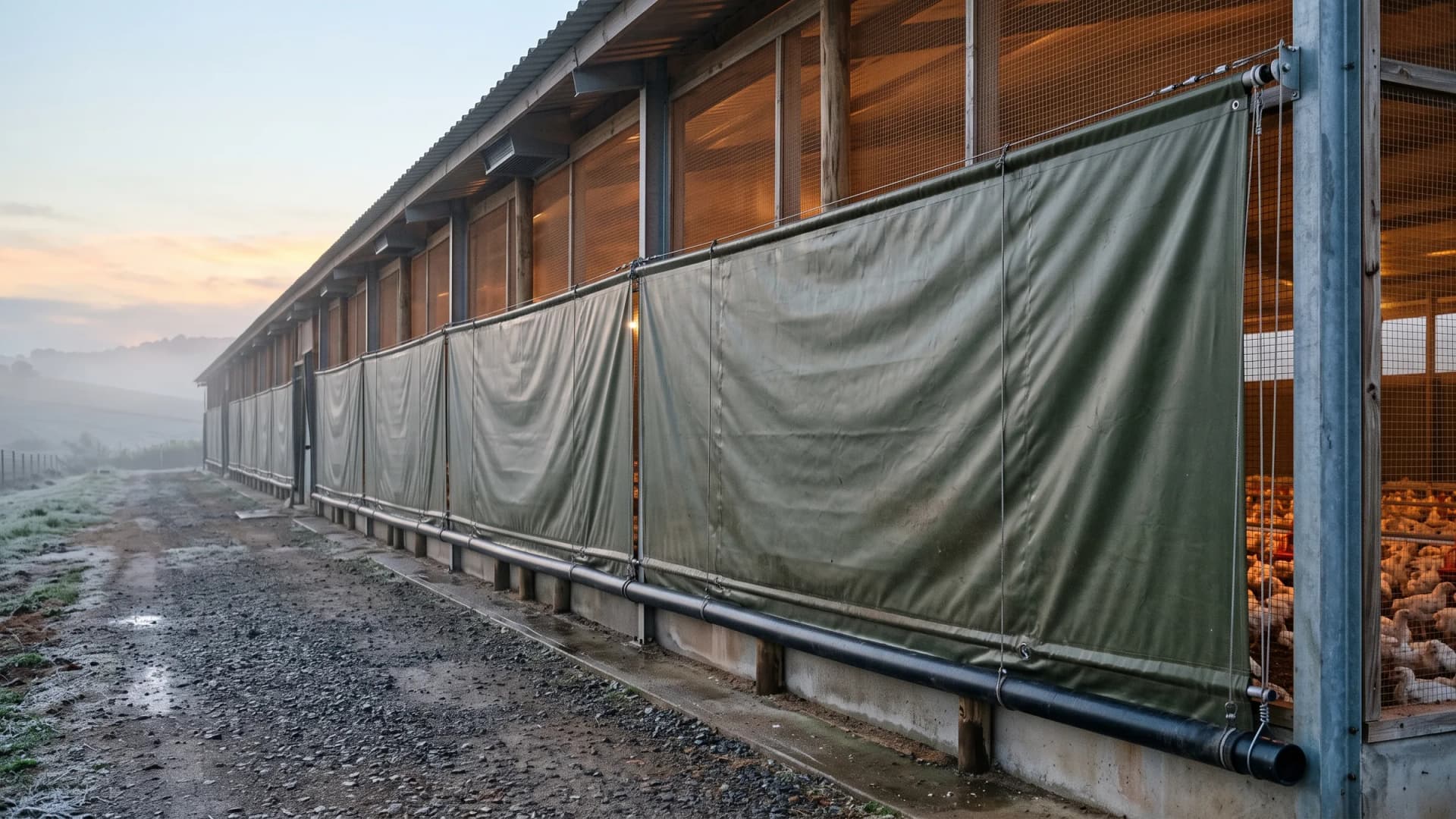
- Holds the heat in. A taut 550 gsm PVC curtain closes the open sidewall into a solid, windproof surface, so brooder and bird heat stays in the house instead of bleeding into the night air.
- Blocks draughts at bird level. The weighted pipe pocket along the bottom hem pins the curtain down, which is where cold air pushes in and where chicks feel it first.
- Still lets you ventilate. Shutting a house completely traps ammonia and moisture. A curtain on a cable and winch lets you crack the top for minimum ventilation while the bottom stays sealed.
- Cuts heating spend. Less heat loss means the brooders and heaters cycle less. Over a winter cycle, that is a real line on the energy bill.
The winter check: eyelets, pockets, and gaps
Curtains fail at the edges first. Before the cold sets in, walk the house and look for:
- Torn or elongated cable eyelets. Standard spacing is 500 mm along the top edge, 300 mm in high-wind areas. A run of failed eyelets lets the curtain sag and gape.
- A worn pipe pocket. The 50 to 75 mm bottom sleeve takes the most abuse. If the pipe is showing through, wind gets under the curtain.
- Patches, pinholes, and flap damage. Small tears grow in winter wind.
All of it is repairable. We weld patches, replace eyelets, and rebuild pipe pockets in our Durban factory, usually at a fraction of the cost of a new curtain. If the curtain is past saving, we quote a replacement against the repair so you can decide.
Made to your house, not a standard size
Every curtain is cut and welded to your house dimensions. Long broiler houses get joined panels with welded overlaps, so length is never the limit. Colour matters in winter too: olive and black give you blackout for grow-out programmes, while white reflects UV and runs cooler in summer, so many farms mix colours by house orientation. The same construction serves piggeries, dairy sheds, calf pens, and greenhouse sidewalls, where clear PVC keeps the light coming through.
Expect 8 to 12 years of service from a curtain in standard poultry use, depending on UV exposure and how often it is rolled.
We manufacture, your team fits
We are a manufacturer. Send your house dimensions and hardware spec, and we build the curtain to match standard SA cable and winch systems, manual crank or motorised. We do not install, which keeps the price down; most farms have a maintenance team or a winch supplier who handles fitting, and we can recommend installers in KZN.
How to order
Measure the opening, note your eyelet spacing and pipe size if you know them, and send it through with a photo of the house. WhatsApp 083 631 5329 and we will quote within 24 hours. There is no minimum order: one replacement panel or a full farm both get built. See the full spec on our agricultural curtains range, and for anything unusual we also do fully custom work.
Frequently asked
550 gsm UV-stabilised PVC, which is the balance between holding house heat, standing up to sun and wind, and staying light enough to raise and lower daily.