
Cold room running you dry? Zone it before you upsize the plant
Most cold rooms are chilling far more air than the product needs. Insulated PVC thermal partitions split the space into real temperature zones, so the compressor cools what matters and leaves the rest alone.
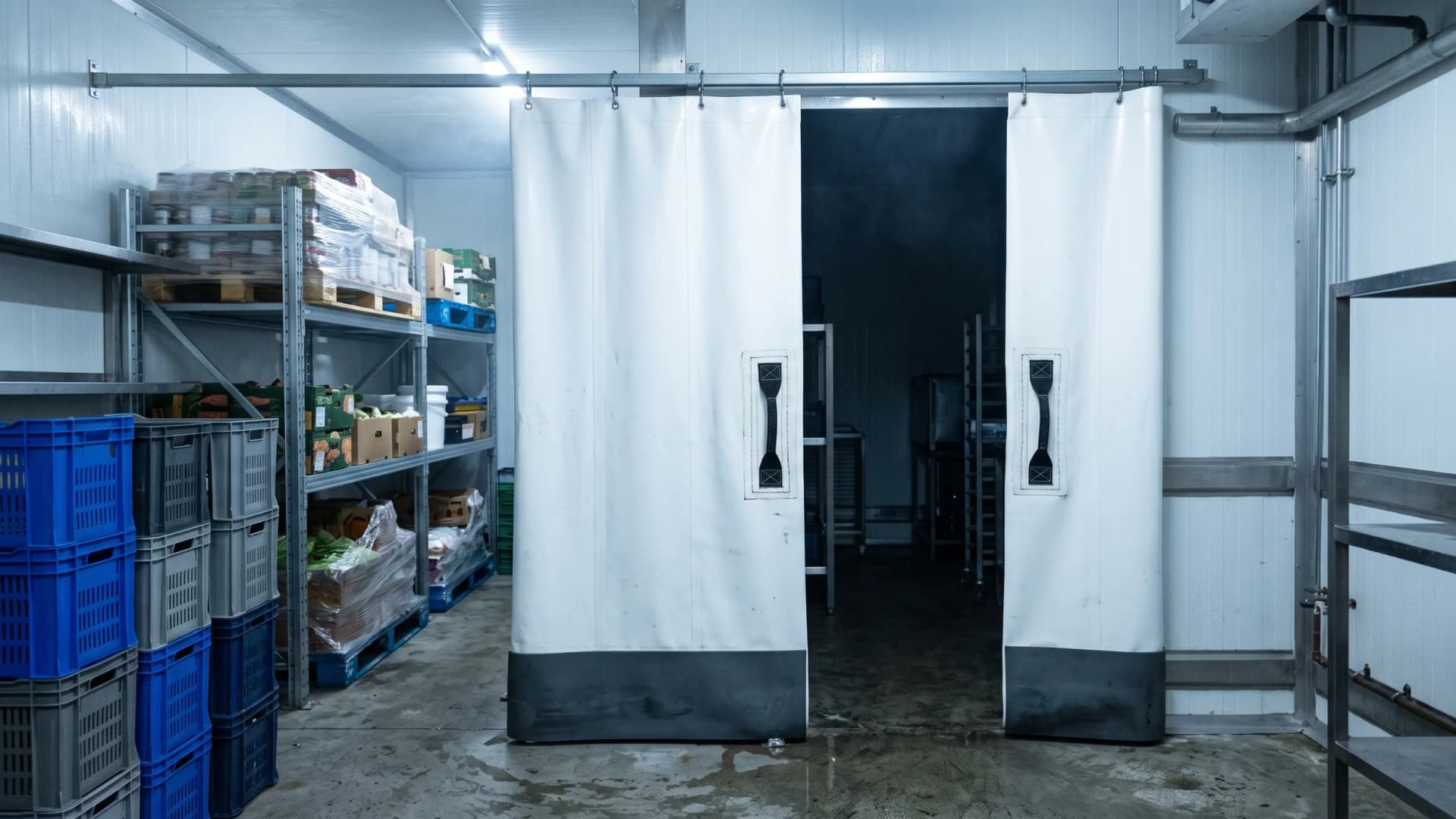
Electricity is the second biggest line on most cold-chain operations after the product itself, and it has not stopped climbing. The instinct when a cold room struggles is to blame the plant and price a bigger unit. Nine times out of ten the plant is fine. The room is simply too big for what is actually in it.
A cold room does not cool product. It cools a volume of air, and then keeps cooling it every time a door opens and warm air rolls in. If you are holding two pallets in a room built for eight, you are paying to chill six pallets of nothing, all day, every day.
Where the money actually goes
Three things drive a cold room's running cost, and only one of them is the compressor:
- The volume you are holding down. Every cubic metre of air in the room gets pulled to setpoint and held there. Empty space costs exactly as much to chill as full space.
- Door openings. Every time the door swings, cold air spills out at floor level and warm, humid air pushes in at the top. The compressor then works to recover the whole room, not just the bit near the door.
- One setpoint for mixed product. If dairy and frozen share a room, the room runs at the colder of the two. You are freezing product that only needed chilling.
None of those get fixed by a bigger compressor. A bigger compressor recovers a badly zoned room faster and bills you more for the privilege.
What a thermal partition changes
A thermal partition is an insulated panel that splits the room into separate zones. It is not a strip curtain and it is not a plastic sheet. Ours are a high-density closed-cell foam core sandwiched between two 800 gsm PVC skins, so the foam does the insulating and the PVC takes the abuse.
Zone the room and three things happen at once:
- You cool the volume you are using. Partition off the working half in the quiet season and the plant holds a smaller box. In winter, or between contracts, you can shut a zone down entirely.
- Door losses stay in one zone. A partition behind the door means a delivery drops the temperature of the entry zone, not the whole room. The product at the back never sees it.
- You run two setpoints in one room. Chilled on one side, frozen on the other, or raw and cooked separated for cross-contamination control. One room does two jobs, and neither product sits at the wrong temperature.
The same logic runs in a refrigerated truck. A partition down a reefer body lets you carry chilled and frozen on one multi-drop run instead of sending two vehicles or compromising on one temperature.
Honest about the numbers
We are a manufacturer, not an energy consultant, and we are not going to hand you a percentage saving off a website. What the saving is depends on your room, your plant, your door discipline, and how much of the space you are genuinely using. What we can tell you is what the operators who order these keep coming back for: they zone a room they were about to replace, and the replacement gets deferred.
If you want a real number before you spend, a refrigeration technician can measure your run hours before and after. Most will do it on a service call.
How they are built
Every partition is made to the specific opening, not cut down from stock:
- 800 gsm PVC exterior on both faces, stain and chemical resistant, wipes down with standard food-industry sanitiser.
- High-density closed-cell foam core doing the actual insulating.
- Scuff board bonded to the bottom edge, both sides. The bottom edge is what pallet jacks, crates, and the floor destroy first. The scuff board takes the hit, and when it wears we replace the board rather than the panel.
- Reinforced webbing handles, stitched through all three layers, so two people can lift and clip a panel into a rail. They do not tear out the way stapled grommets do.
- Colour coded by zone. Blue for chilled, red for frozen, white for ambient is the convention we have supplied for years, and it means staff can see which zone they are walking into.
Refurbishment, and repairs regardless of who made them
A worn partition does not need scrapping. Bring in your existing panels and we re-skin them in new PVC, fit fresh scuff boards, and re-stitch the handles where they have pulled. The foam core gets reused wherever it is still sound. A refurbishment costs a fraction of a new panel.
That goes for partitions we did not build, too. We repair existing thermal partitions and cold-chain curtains regardless of who made them: skin patches, scuff-board replacement, handle re-stitching, and full re-skins on a sound core. Phone us before you write a set off.
How to order
For a cold room, send the internal width and height of the opening you want to close, and a note on what you are storing on each side. For a reefer body, send the internal width, height, and rail position, or just the vehicle make and model. We hold templates for most SA refrigerated bodies including Serco, Lamberet, and Thermo King.
WhatsApp 083 631 5329 and we will come back within 24 hours with a spec, a price, and a lead time. There is no minimum order: one panel or a standardised set across a 40-truck fleet. Full detail on the range sits on our thermal partitions page, and for anything the standard build does not cover we also do fully custom work.
Frequently asked
We will not put a percentage on it, because the honest answer depends on your room, your plant, your door discipline, and how much of the space you actually use. A refrigeration technician can measure your run hours before and after, and most will do it on a service call.