
Koi winter pond care: getting your fish through a South African winter
Cold water slows koi right down. How to feed, aerate, and cover a pond through a SA winter, and why winter is the right season for liner repairs, with a holding vat keeping your fish safe while you work.
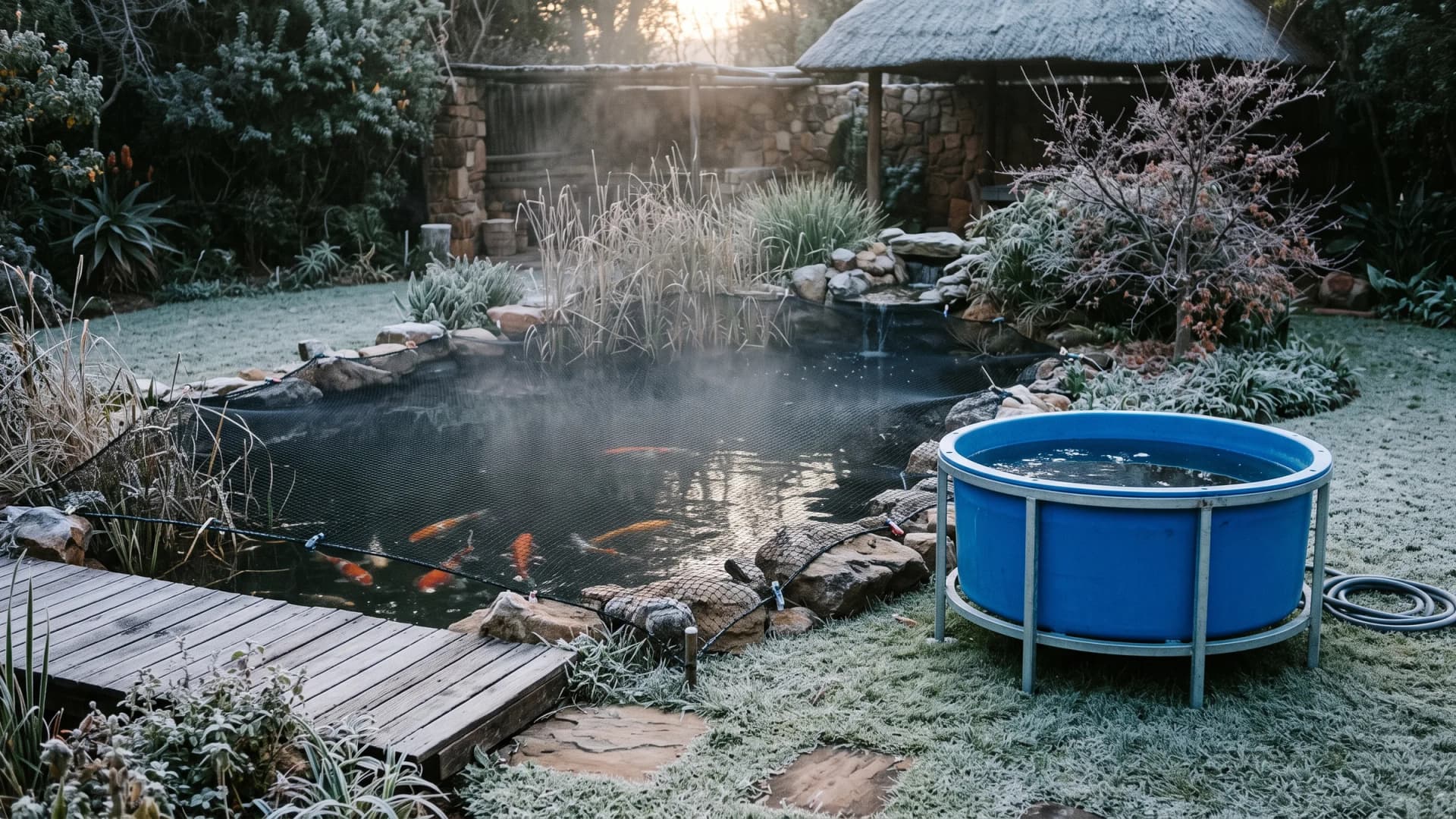
A highveld pond can drop below 10 degrees on a cold snap, and even coastal KZN ponds sit well under summer temperatures through July. Koi are cold-blooded, so their metabolism tracks the water: below about 15 degrees they slow down, and below 10 they more or less stop. Most winter losses come from keepers treating a torpid fish like a summer fish. The fixes are simple, and winter is also the one season when real pond maintenance is practical.
Feed by the thermometer, not the calendar
A koi's gut slows with the water temperature. Food that sits undigested in a cold fish causes more winter deaths than the cold itself.
- Below 15 degrees, switch to a wheatgerm-based food that digests easily, and feed less, only what the fish clear in a few minutes.
- Below 10 degrees, stop feeding. The fish live off condition built in autumn, which is normal and safe.
- Buy a pond thermometer. Air temperature tells you very little; a sunny winter afternoon on the highveld can follow a near-freezing night.
Keep the water moving, but leave the bottom alone
In winter the warmest, most stable water sits at the bottom of the pond, and that layer is where your koi settle. Keep the pump and aeration running so the surface exchanges gases, but lift the pump intake off the floor so you are not stripping the warm layer and mixing it with cold surface water. Deeper ponds ride out cold snaps better for the same reason: more stable water for the fish to hold in.
Cover the pond
Two winter problems, one fix. Falling leaves foul the water just as the biological filter slows down, and herons hunt harder in winter, when a torpid koi near the surface is easy pickings. A bird-proof net cover, in black or forest green, cut to fit your pond or vat rim with a drawstring or elastic edge, deals with both. It is the cheapest insurance on the pond.
Winter is repair season
If your liner has been weeping all summer, this is the season to fix it. The fish are slow and easy to move, algae growth is at its lowest, and a drained pond refills into cool, stable water rather than a summer algae bloom.
The working method is a holding vat. Our koi vats run from 1.5 m to 4 m diameter and 0.5 m to 1.2 m deep: 800 gsm PVC, RF-welded seams with no stitch holes and no contamination risk, on a galvanised steel ring frame that dismantles in 10 minutes. Set one up beside the pond, move the fish across with aeration, and take your time on the repair. The 50 mm bulkhead drain with ball valve empties it by gravity when you are done. We have supplied regional KOI societies across the country for over 20 years on exactly this construction.
For the pond itself, we weld single-sheet liners in up to 1050 gsm UV-stable PVC, cut to fit any pond shape, up to 6 m x 4 m as one sheet and bigger with on-site seam welding. And if a vat or liner ever fails, we repair it in-house at the Durban factory rather than selling you a new one.
A winter checklist
- Thermometer in the pond, feeding matched to the reading
- Wheatgerm food below 15 degrees, nothing below 10
- Pump running, intake lifted off the bottom
- Net cover fitted before the leaves and the herons arrive
- Liner leaks booked for repair now, not in spring
- Battery aerator on standby for load shedding
How to order
Tell us your pond or vat dimensions and what you need: a net cover, a holding vat, a replacement liner, or a repair. WhatsApp 083 631 5329 and we will quote within 24 hours. There is no minimum order. The full range and sizes are on our ponds and tanks page, and if you want to see the vats in use, read about Minurphy at the 2026 Gauteng Koi Show.