
Bun partitions: what each part does, and how to make one last
A bun partition is four parts, and each one does a job. What the PVC skin, foam core, scuff board, and webbing handles are for, what to ask a supplier, and a simple care routine that keeps a partition in service for years.
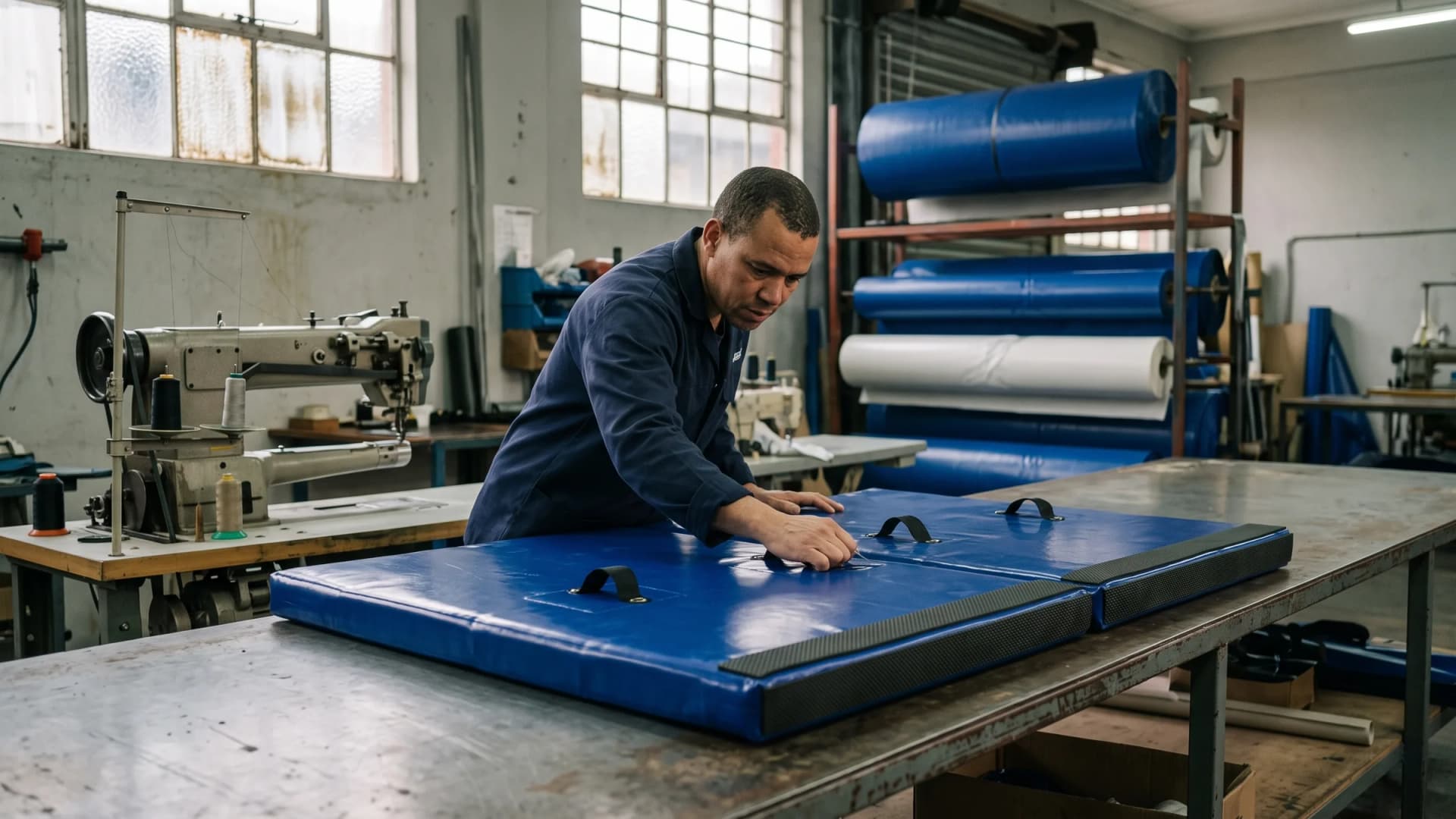
A bun partition looks simple: a padded blue wall in the back of a refrigerated truck. But it is four parts, and each one does a specific job. Know what each part is for and you know what to ask for when you buy, what to check while it is in service, and when it is worth refurbishing rather than replacing.
The four parts, and what each one does
800 gsm PVC skin. The skin is what the partition shows to the world: crates, boots, pallet jacks, cleaning chemicals, and two people lifting it in and out every day. We work in 550, 700, and 800 gsm PVC, and partitions get the heaviest, on both faces. It is stain and chemical resistant and wipes clean, which matters on anything that stands between two food loads.
High-density foam core. The foam is what actually insulates. The PVC protects the foam, and the foam holds the temperature difference between the zones. High-density foam keeps its shape under handling, so the partition stays a firm wall rather than sagging into a pad.
Scuff board. The bottom of a partition takes the most punishment. Pallet jacks, crates dragged across the floor, and boots all hit the same place. A scuff board sits there and takes the knocks so the PVC skin does not. It is a wear part by design: when it is worn, it gets replaced on its own.
Webbing handles. A partition is no use if it is too awkward to move. Webbing handles let two people lift it, fit it, and move it forward as the drops come off. Ours are stitched through the partition, so they spread the load into the panel rather than sitting on one weak point.
What to ask a supplier
Before you order, from us or anyone else, get answers to these:
- What PVC weight is on each face? Both faces take handling and cleaning, not just the one you see.
- What is inside? You want a high-density foam core, not a thin layer of padding.
- Is there a scuff board, and can it be replaced on its own?
- How are the handles attached? Stitched-through webbing outlasts handles that are stapled or riveted on.
- Is it made to my truck body? A partition that is too small leaks air around the edges. One made to your body closes the gap.
- Can it be repaired later? A partition that can be re-skinned is one you buy once.
A simple care routine
- Wipe it down. Clean both faces with your standard food-industry sanitiser, then let it dry before you stack or store it.
- Lift it, do not drag it. Use the handles. Dragging wears the bottom edge and the scuff board long before their time.
- Check the skin. Look for splits and punctures. A split lets moisture and dirt get in behind the PVC, where you cannot clean them, so fix it early.
- Check the scuff board. If it is worn through, replace it before the PVC behind it starts to wear.
- Check the handles. Pulled stitching or fraying webbing gets re-stitched before a handle tears out under load.
- Store it out of harm's way. When a partition is out of the truck, stand it or lay it flat away from pallet jack and forklift traffic.
Refurbish rather than replace
A worn partition usually has a sound core. We re-skin partitions in new PVC, fit fresh scuff boards, and re-stitch handles, reusing the foam wherever it is still good. A refurbishment costs a fraction of a new partition and comes back ready for service. We do this for partitions regardless of who made them, so send a photo before you write a set off.
Where to go next
If you are still deciding whether a partition suits your operation, our article on carrying chilled and frozen on one truck covers what a partition does in a refrigerated body and what your refrigeration unit needs to do alongside it.
How to order
WhatsApp 083 631 5329 with the internal width and height of the truck body where the partition will stand, how many you need, and a photo of the inside of the body. For a refurbishment, send photos of the partition and the damage. We come back within 24 hours with a price and lead time, and there is no minimum order. Full specs are on our thermal partitions page.
Frequently asked
Ours are a high-density foam core inside 800 gsm PVC on both faces, with a scuff board to take the knocks and webbing handles for lifting and fitting. The foam does the insulating and the PVC protects the foam.