
Taking the pool cover off: the spring checklist that makes it last another winter
How you lift, clean, and store a PVC pool cover in spring decides whether it sees another winter or a new one gets quoted in May. Five steps, plus what is worth repairing before you pack it away.
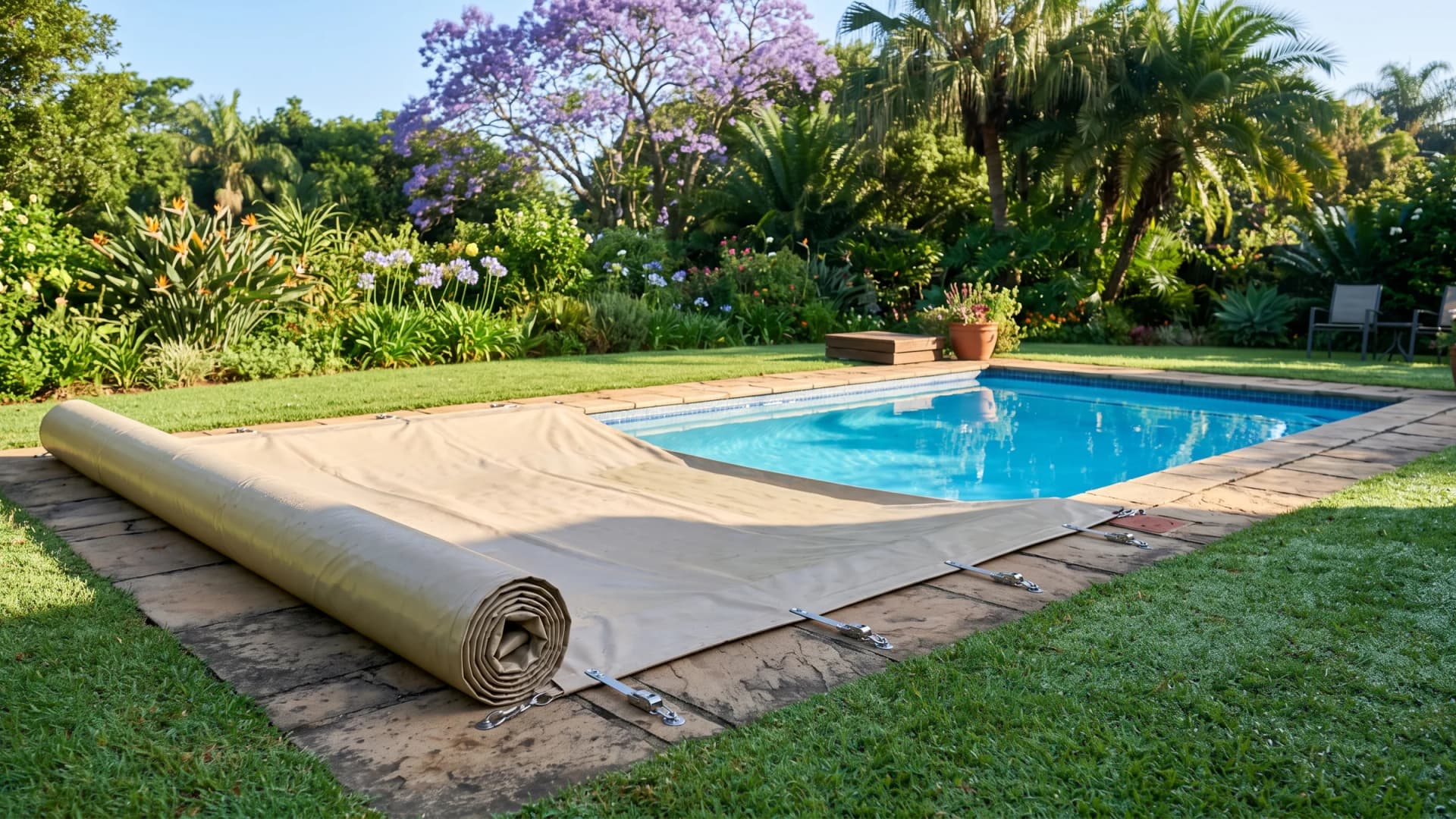
Spring in South Africa arrives quickly. One weekend the pool is a dark rectangle under a cover and the next it is 27 degrees and the kids are in. What usually happens next is that the cover gets dragged off, folded wet, and shoved behind the pump house until May.
That is where pool covers die. Not on the pool over winter, where they are tensioned and doing their job, but in a heap in a hot store room for six months. Twenty minutes of work now is the difference between a cover that lasts a decade and one you are quoting again next autumn.
1. Lift it dry, and lift it clean
Do not pull the cover off with the winter's worth of leaves still on it. Sweep or hose the debris off while the cover is still tensioned over the water: it is a flat, supported surface, which is the easiest it will ever be to clean. Brush from the middle outwards to the edge.
If there is standing water in a dip, pump or sweep it off first. Dragging a cover that is holding fifty litres puts all that weight onto a couple of fittings and the eyelets around them, which is exactly how a cover tears at the edge rather than in the middle.
2. Wash it with the right thing, which is almost nothing
Warm water, a soft broom, and a mild dish soap. That is it.
What kills PVC is the shortcut: never clean a cover with chlorine, pool acid, bleach, thinners, or a high-pressure washer. Chlorine at cleaning strength attacks the plasticiser in the PVC and leaves the sheet stiff and chalky. A pressure washer opens up welded seams. If there is algae staining that will not shift with soap, phone us before you reach for anything stronger.
Rinse properly. Soap residue left to bake on a folded cover marks it permanently.
3. Let it dry completely, both sides
This is the step everyone skips and the one that does the most damage. A cover folded away damp grows mildew in a dark store room within weeks, and mildew staining on PVC does not wash out.
Lay it over a wall, a trailer, or the lawn, give it an hour a side in the sun, and check the folds and the hem where water hides. Dry means dry to the touch everywhere, including inside any hem or pocket.
4. Inspect it before you fold it, not after
While it is flat and dry, walk the whole cover once and look at four things:
- The seams. Run a hand along every weld. Any spot that feels ridged, lifted, or tacky is a seam starting to let go.
- The edge and the eyelets. This is where covers fail. Look for eyelets that have pulled, elongated, or torn through, and any fraying on the hem.
- Abrasion points. Wherever the cover has been rubbing on a coping edge, a step, or a fitting, the PVC will have gone thin and slightly matt before it goes through.
- UV chalking. Rub the top surface. If your palm comes back with a fine powder, the surface has taken a lot of sun and the cover is in the second half of its life. Worth knowing before next winter, not in the middle of it.
Photograph anything you are unsure about and send it through. It costs nothing to ask.
5. Fold it loose, store it cool and dark
Fold, do not scrunch, and vary where the folds fall from one year to the next so you are not creasing the same lines repeatedly. A hard crease in the same place every season is a future split.
Store it flat or loosely rolled, off a concrete floor, somewhere cool, dark, and dry. Not in a black bag in a hot roof space, not out in the sun on the lawn all summer, and not where rodents can get at it. A roof void in a KZN summer will do more damage in three months than the whole winter on the pool did.
Repair it now, not in April
The best time to fix a pool cover is the day you take it off, while the damage is fresh in your mind and there is no rush on it. In April everyone phones at once and wants it back before the first cold front.
We repair pool covers regardless of who made them. Because it is welded PVC, almost everything is fixable: seam re-welds, patches over tears and abrasion, new eyelets and edge reinforcement where the old ones have pulled through, and hem repairs. Most jobs cost a small fraction of a new cover and add years to it.
If the cover is genuinely finished, spring is also the sensible time to replace it. We cut and weld to the actual shape of your pool, whether it is rectangular, freeform, kidney, or has steps and a tanning ledge, in PVC from 550 gsm up to 800 gsm depending on how exposed the pool is and how much foot traffic the cover takes. For a spa or jacuzzi we build an insulated version that holds heat overnight. There is no minimum order, and we keep your template on file so a replacement or a second cover is quick.
While the cover is off
Two things worth doing in the same weekend, since you are already out there:
- Check the tension fittings and anchors around the pool edge, not just the cover. A fitting that has rusted or worked loose over winter will be the thing that tears the cover next season.
- Sort the summer shade. If the reason nobody sits by the pool at midday is that there is no cover overhead, that is a canvas awning or a set of blinds and awnings job, and lead times are far shorter now than they are in December.
How to order
For a repair, send photos of the damage and the overall cover. For a new cover, send the pool dimensions, or a photo with a tape measure in frame for the odd shapes, plus a note on whether it is a pool, spa, or jacuzzi.
WhatsApp 083 631 5329 and we will come back within 24 hours with a spec, a price, and a lead time. Pool and jacuzzi covers sit under our equipment and asset covers range, and if you are new to custom covers our winter pool cover guide covers what one actually does for the water.
Frequently asked
Warm water, a soft broom, and a mild dish soap, then rinse properly. Never use chlorine, pool acid, bleach, thinners, or a high-pressure washer. Chlorine at cleaning strength attacks the plasticiser and leaves the sheet stiff and chalky; a pressure washer opens welded seams.