
Backup water for outages: sizing and siting a collapsible PVC tank
When the taps run dry for three days, the water you miss most is not the water you drink. How to size a backup tank for your household, where to stand it, and why a collapsible PVC tank suits homes that cannot take a permanent one.
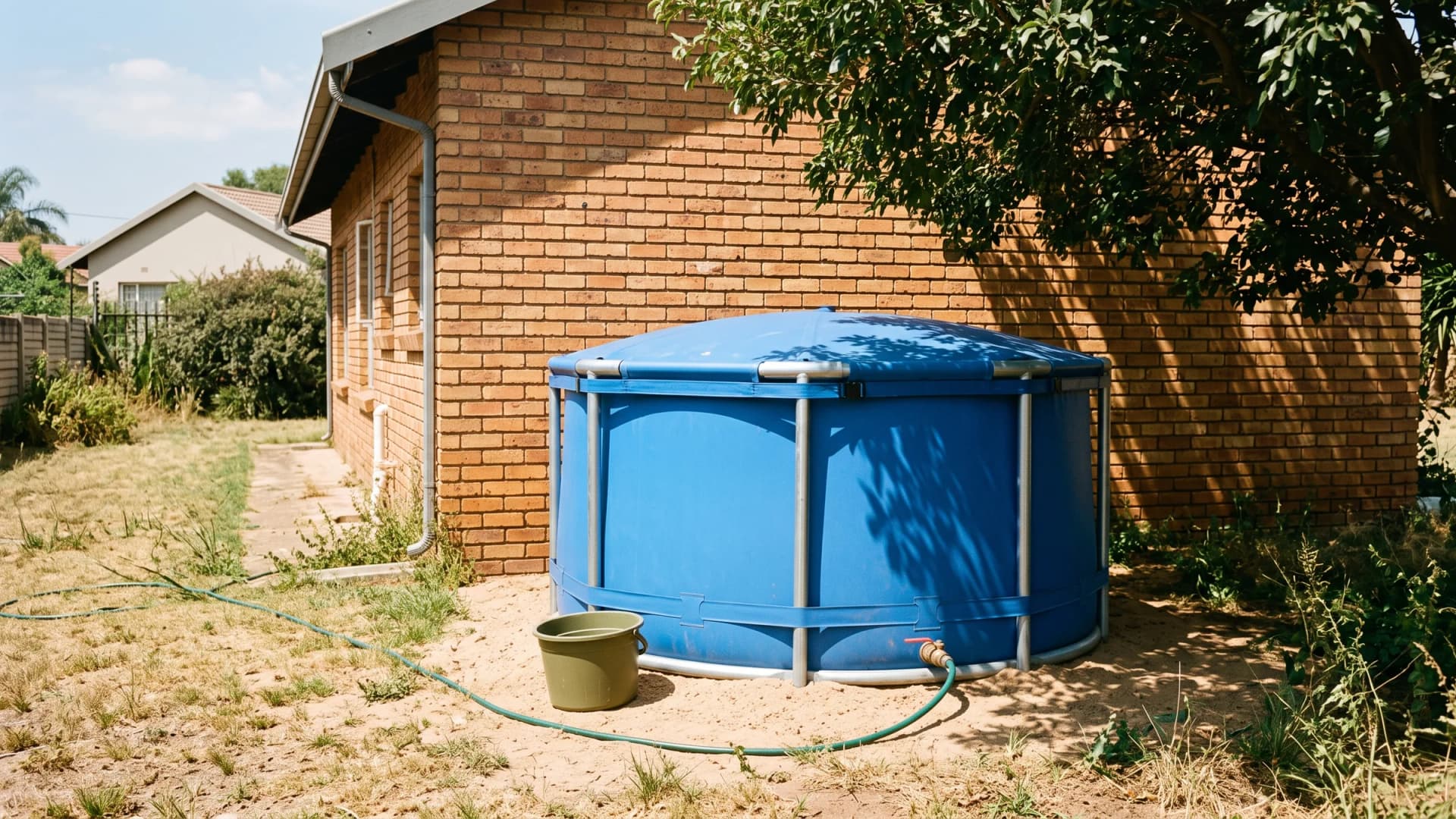
Water outages have become part of life in a lot of South African suburbs: planned maintenance that runs days over, a burst main, a reservoir that cannot recover, a pump station that stops when the power does. Most households have learned to keep bottled water for drinking. What catches people out is everything else.
On day two of an outage, the problem is not thirst. It is the toilets.
Size it by what you use, not what you drink
Drinking water is a few litres per person per day, and a case of sealed bottles covers it. The volume goes on flushing, washing, and the kitchen. For a household of four on a genuine outage footing, it looks roughly like this:
| Use | Rough daily volume, household of four |
|---|---|
| Toilet flushing (four people, four flushes each, 9 litre cistern) | About 145 litres |
| Washing from a basin or bucket | About 60 litres |
| Dishes and cooking | About 20 litres |
| Cleaning, pets, and the odd emergency | About 15 litres |
| Total | About 240 litres a day |
So as a rule of thumb, every 1,000 litres of storage covers a household of four for about four days of essentials. Newer dual-flush cisterns use a lot less than 9 litres, so if yours are modern the tank goes further.
That gives you a way to choose:
- 1,000 litres: smaller households and short outages, the typical weekend of maintenance work.
- 2,000 to 3,000 litres: a family of four through a full week.
- 5,000 litres and up: larger households, guesthouses, small businesses, or anyone topping up from a borehole or the roof.
Why a collapsible tank
The fixed polyethylene tank on a stand is a good answer if you own the house, have the space, and want it there forever. A lot of households do not fit that description.
- Renters, who cannot bolt a permanent tank to someone else's property and want to take it with them.
- Sectional title and estate homes, where a permanent tank is a longer conversation with the body corporate.
- Tight access. A 5,000 litre rigid tank does not go through a side gate or a house. A collapsible one arrives in a carry bag.
- Seasonal or temporary need: a building project, a farm season, an event, or a business that only needs a reserve while outages are frequent.
Our backup tanks run from 1,000 to 10,000 litres. The kit is a galvanised steel ring frame, an 800 gsm PVC liner with RF heat-welded seams, a lockable lid, and a 50 mm gravity-drain bulkhead, with an optional inlet fitting for a pump or gravity feed. When the outages ease, the frame dismantles and the liner folds back into its bag. It is the same welded construction as our koi vats and ice baths, which is to say, built to hold water without weeping.
Where to stand it
Weight first. Water weighs a kilogram a litre, so a full 5,000 litre tank puts five tonnes on its footprint. That needs:
- Level, compacted ground or a concrete slab. A tank on a slope loads one side of the frame harder than the other.
- A clean surface. Clear stones, roots, and anything sharp. A groundsheet under the liner is cheap insurance.
- Nothing buried underneath. Keep it off septic tanks, soakaways, and pipe runs.
- Shade, if you can get it. Sun warms stored water, and UV is what ages PVC over the years.
Then think about how you will get the water out. The drain valve sits at the base, so on its own the tank feeds a hose to the garden or fills a bucket for the toilets. If you want tank water at your taps, a registered plumber fits a pump and the right non-return valves so it cannot flow back into the municipal line. Do not improvise that connection.
Filling it and keeping it fresh
Fill it while the supply is on, and top it up the moment an outage notice goes out. A borehole or a gutter downpipe feeding the inlet fitting works too.
Keep the lid closed and locked. It keeps out light, which grows algae; mosquitoes, which breed in any open water; and leaves and dust. With small children or dogs around, a locked lid is a safety item, not an extra.
Water that sits for months goes stale. When there has been no outage for a few weeks, run the tank into the garden and refill it. That keeps your reserve fresh and gives the garden a drink it would otherwise not get.
Keep the tank for working water and keep sealed bottled water for drinking. It is the simplest arrangement and it covers both needs.
If you already have a tank
A frame tank or liner that is weeping at a seam or has a puncture is usually a welded repair, not a new tank. We repair PVC tanks, vats, and covers regardless of who made them. Send a photo of the damage and one of the whole tank.
How to order
Tell us how many people are in the household (or what the business uses), roughly how long your outages tend to run, and send a photo of where the tank will stand. Mention whether you want the inlet fitting. WhatsApp 083 631 5329 and we will come back within 24 hours with a size recommendation, a price, and a lead time. We deliver SA-wide. The tank is built the same way as our PVC ice baths, just a great deal bigger, and it folds back into its carry bag when you pack it away.
Frequently asked
Work from what you use, not what you drink. A household of four gets through roughly 240 litres a day on essentials (flushing, washing, dishes, and cleaning), so every 1,000 litres covers about four days. Our collapsible tanks run from 1,000 to 10,000 litres.